
Agreement records can have different agreement types that are configurable.
Common Agreement Types
Inter-Institutional – Lead
An office is managing the prosecution and licensing of the technologies and/or patents. For invoicing of reimbursements under these agreements, a reimbursement account should exist for each technology or patent related to the agreement (established automatically by Inventions for newly created or ongoing invoicing. If there is an administrative fee that is associated with the IIA – Lead agreement, that information should be entered and maintained in the header of the agreement. The admin fee percentage (or flat fee) data is used for any subsequent license agreements that are related to the IIA technology.
Inter-Institutional – Non-Lead
Another party is managing prosecution and subsequent license agreements. It is recommended to set up the home organization as the co-owner and the external leading party as the owning organization in the Groups section of the agreement.
Inter-Institutional – Co-Lead
Responsibilities for prosecution and licensing of the technologies and/or patents is shared. For invoicing of reimbursements under these agreements, a reimbursement account should exist for each technology or patent related to the agreement (established automatically by Inventions for newly created or ongoing invoicing. If there is an administrative fee that is associated with the IIA – Lead agreement, that information should be entered and maintained in the header of the agreement. The admin fee percentage (or flat fee) data is used for any subsequent license agreements that are related to the IIA technology. If a payment is being made to another institution for reimbursement of their patent expenses, an account should be set up as a patent expense – third party. Expenses within accounts of this type are billable to licensees, but not to other IIAs.
Intra-Institutional
Sharing costs within the organization. At times it may be necessary to invoice a college, lab, or department for expenses incurred. For invoicing to the other organization to be properly recorded in Inventions, create an intra-institutional agreement type and link any technologies or patents for which there is a shared responsibility by utilizing the reimbursement schedule. As with inter-institutional agreements, a warning message will appear when generating an invoice if there is an active license agreement related to any of the technologies or patents.
Tangible Property Agreements/Deposit Agreements
A third-party is to receive a portion of revenue. This can be set up similarly to inter-institutional agreements.
Non-Disclosure Agreement
This agreement type is the same as a Confidential Disclosure Agreement. Sometimes this is referred to as an NDA or CDA. This type of Agreement outlines the terms under which two or more parties will keep one or more of the counter-parties' information confidential.
License Agreement
A legal, written contract between two parties wherein the property owner gives permission to another party to use their brand, patent, or trademark.
Material Transfer Agreement
A contract that governs the transfer of tangible research materials between two organizations.
Plant Variety Protection (PVP) Agreement
Provides protection of intellectual property rights to breeders of new varieties of seeds and tubers.
Configuration
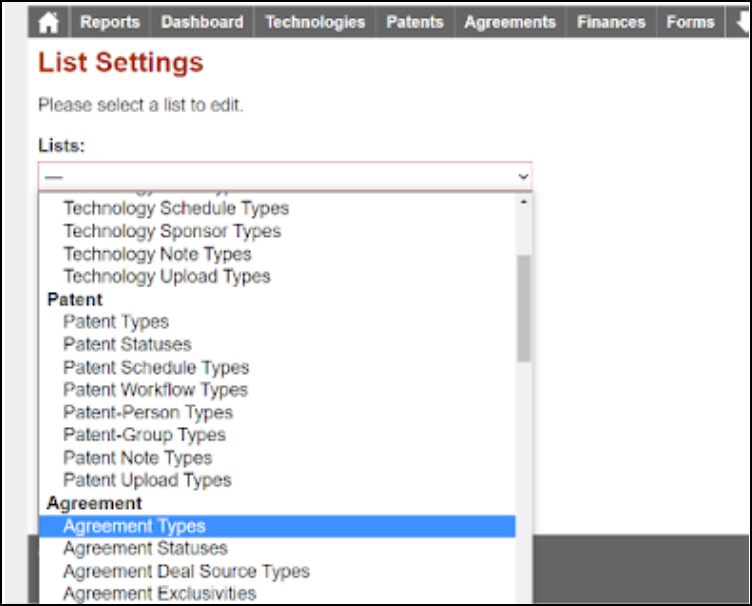
To configure agreement type options, go to the Settings tab in the Inventions navigation header. In the Admin Tools section, click on List Settings.
Click on the dropdown menu at the top of the screen. Scroll to the Agreement section and click on Agreement Types.
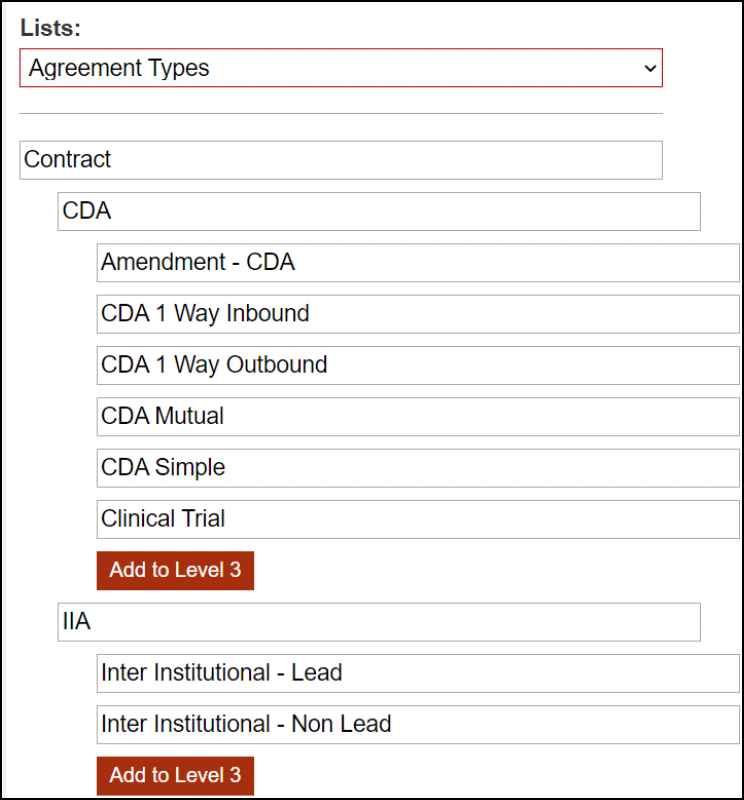
The list of configurable options will display on the screen. These are populated within the Agreement type dropdown selection.
To add a new option, select Add to Level X. If an Agreement type should be a sub-type of another type, add the new sub-type as a Level 2 option.
For example, if CDA Mutual should be a sub-type of CDA, add CDA Mutual as Level 2.
Once finished, be sure to click Save Changes at the bottom of the screen.